In my four decades of advising family-owned enterprises, I have seen markets collapse, technologies vanish, and generations rise and fall. Yet, the horizon we face in 2026 is unlike any other. We are currently navigating a “permacrisis,” a state of structural volatility in which geopolitical shifts, AI integration, and the largest wealth transfer in history are converging.
For the founders and owners I work with, the question is no longer just “How do we grow?” but “How do we endure?”
The New Governance: Beyond the Dinner Table
There was a time when a “handshake and a heritage” were enough to keep a family business aligned. In 2026, that is a recipe for litigation and loss. As businesses scale, the informal “trust-based” models of the past must evolve into professionalized governance.
We are seeing a massive shift toward formal family councils and independent boards. According to recent data, family businesses led by women or those with at least three independent directors are significantly outpacing their peers in risk mitigation and revenue growth. Why? Because they introduce objectivity into emotional spaces.
Effective governance in this new era requires managing the intersection of the Three-Circle Model: Family, Ownership, and Business. My advice to owners today is simple: If your shareholder agreement hasn’t been touched in five years, it is likely a liability. Professionalizing doesn’t mean “de-familizing” your business; it means protecting the family from the business, and vice versa.
The Next-Gen Contract: Interest vs. Preparedness
We are in the midst of a historic leadership transition. However, the “Next-Gen” of 2026 has a different value set. They prioritize purpose, sustainability, and work-life balance over the “growth-at-all-costs” mentality of the Boomer generation.
I often tell my clients that succession is a marathon, not a ribbon-cutting ceremony. The most successful transitions I’ve facilitated lately focus on two pillars:
- Interest: Does the next generation actually want to lead, or are they acting out of obligation?
- Preparedness: Have they earned their stripes outside the family bubble?
The “Consortium of Cousins” (the 3rd and 4th generations) faces a structural cohesion crisis. Without a clear Family Charter—a document that outlines values, employment policies, and conflict resolution, the “blood is thicker than water” sentiment can quickly become a drain on capital.
Digital Transformation with a Human Soul
By 2026, AI and automation are no longer optional “tech projects”; they are existential requirements. However, the family business advantage has always been the “human touch.”
The challenge for today’s owners is to use technology to scale efficiency while doubling down on the values that make them unique. Whether it’s moving toward a circular economy or utilizing AI to predict supply chain disruptions, the goal is resilience.
To My Fellow Advisors
For the lawyers, CPAs, and financial planners reading this: our role has changed. We are no longer just “technical experts.” We must be behavioral architects. In a world where 26% of family firms are considering private equity or external investment, our job is to help them navigate these “ownership shake-ups” without losing their soul.
We must move away from “off-the-rack” legal and financial solutions. Every family is a unique ecosystem. Our value lies in bridging the gap between the founder’s legacy and the successor’s vision.
The Bottom Line
The future of the family business is bright, but it is also demanding. It requires a “reset” of leadership—moving from operational overload to strategic discipline. After forty years in the trenches, I can tell you this: the businesses that survive are not those with the most capital, but those with the most clarity.
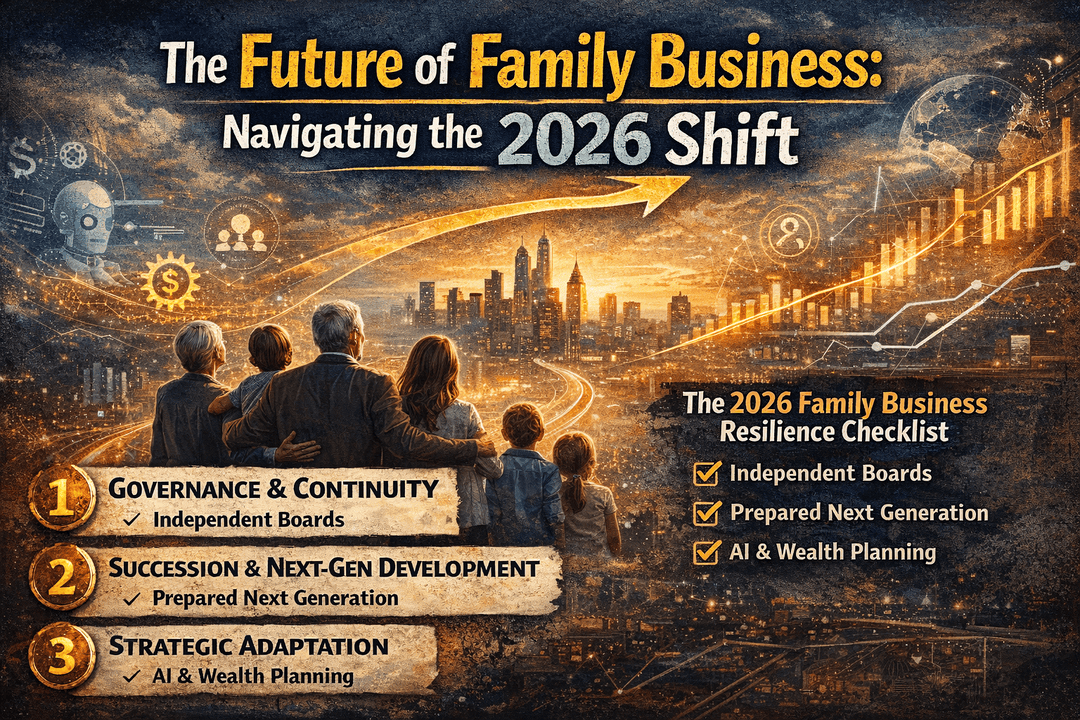
The 2026 Family Business Resilience Checklist
1. Governance & Continuity
- The “Five-Year Rule”: Have our Shareholder Agreements, Wills, and Power of Attorneys been reviewed by our legal and tax teams since 2021?
- Independent Oversight: Do we have at least one non-family, independent voice on our board to provide objective “outside-in” perspectives?
- The Family Charter: Is there a written document defining how family members enter, exit, and are compensated within the business?
2. Succession & Next-Gen Development
- The “Outside Experience” Clause: Are we requiring the next generation to work for a non-competitor for 3–5 years before joining the family firm?
- Psychological Readiness: Beyond technical skills, does the next generation demonstrate the emotional intelligence required to manage family dynamics?
- Active vs. Passive Ownership: Have we clearly defined the difference between being an owner (entitled to dividends) and an employee (entitled to a market-rate salary)?
3. Strategic Adaptation
- Digital Integration: Have we identified the top three areas where AI can reduce operational drag without compromising our “family-brand” service?
- Wealth Diversification: Is too much of the family’s total net worth tied up in the operating company? Are we working with our financial planners to create “exit ramps” or liquidity events?
- Legacy vs. Strategy: Are we holding onto a legacy product line or service out of sentimentality rather than profitability?
Expert Insight: In my experience, the families that thrive are the ones that treat their communication with the same rigor they treat their balance sheet. Silence in a family business is rarely peace; it is usually a pending storm.In my four decades of advising family-owned enterprises, I have seen markets collapse, technologies vanish, and generations rise and fall. Yet, the horizon we face in 2026 is unlike any other. We are currently navigating a “permacrisis,” a state of structural volatility in which geopolitical shifts, AI integration, and the largest wealth transfer in history are converging.
For the founders and owners I work with, the question is no longer just “How do we grow?” but “How do we endure?”
The New Governance: Beyond the Dinner Table
There was a time when a “handshake and a heritage” were enough to keep a family business aligned. In 2026, that is a recipe for litigation and loss. As businesses scale, the informal “trust-based” models of the past must evolve into professionalized governance.
We are seeing a massive shift toward formal family councils and independent boards. According to recent data, family businesses led by women or those with at least three independent directors are significantly outpacing their peers in risk mitigation and revenue growth. Why? Because they introduce objectivity into emotional spaces.
Effective governance in this new era requires managing the intersection of the Three-Circle Model: Family, Ownership, and Business. My advice to owners today is simple: If your shareholder agreement hasn’t been touched in five years, it is likely a liability. Professionalizing doesn’t mean “de-familizing” your business; it means protecting the family from the business, and vice versa.
The Next-Gen Contract: Interest vs. Preparedness
We are in the midst of a historic leadership transition. However, the “Next-Gen” of 2026 has a different value set. They prioritize purpose, sustainability, and work-life balance over the “growth-at-all-costs” mentality of the Boomer generation.
I often tell my clients that succession is a marathon, not a ribbon-cutting ceremony. The most successful transitions I’ve facilitated lately focus on two pillars:
- Interest: Does the next generation actually want to lead, or are they acting out of obligation?
- Preparedness: Have they earned their stripes outside the family bubble?
The “Consortium of Cousins” (the 3rd and 4th generations) faces a structural cohesion crisis. Without a clear Family Charter—a document that outlines values, employment policies, and conflict resolution, the “blood is thicker than water” sentiment can quickly become a drain on capital.
Digital Transformation with a Human Soul
By 2026, AI and automation are no longer optional “tech projects”; they are existential requirements. However, the family business advantage has always been the “human touch.”
The challenge for today’s owners is to use technology to scale efficiency while doubling down on the values that make them unique. Whether it’s moving toward a circular economy or utilizing AI to predict supply chain disruptions, the goal is resilience.
To My Fellow Advisors
For the lawyers, CPAs, and financial planners reading this: our role has changed. We are no longer just “technical experts.” We must be behavioral architects. In a world where 26% of family firms are considering private equity or external investment, our job is to help them navigate these “ownership shake-ups” without losing their soul.
We must move away from “off-the-rack” legal and financial solutions. Every family is a unique ecosystem. Our value lies in bridging the gap between the founder’s legacy and the successor’s vision.
The Bottom Line
The future of the family business is bright, but it is also demanding. It requires a “reset” of leadership—moving from operational overload to strategic discipline. After forty years in the trenches, I can tell you this: the businesses that survive are not those with the most capital, but those with the most clarity.
The 2026 Family Business Resilience Checklist
1. Governance & Continuity
- The “Five-Year Rule”: Have our Shareholder Agreements, Wills, and Power of Attorneys been reviewed by our legal and tax teams since 2021?
- Independent Oversight: Do we have at least one non-family, independent voice on our board to provide objective “outside-in” perspectives?
- The Family Charter: Is there a written document defining how family members enter, exit, and are compensated within the business?
2. Succession & Next-Gen Development
- The “Outside Experience” Clause: Are we requiring the next generation to work for a non-competitor for 3–5 years before joining the family firm?
- Psychological Readiness: Beyond technical skills, does the next generation demonstrate the emotional intelligence required to manage family dynamics?
- Active vs. Passive Ownership: Have we clearly defined the difference between being an owner (entitled to dividends) and an employee (entitled to a market-rate salary)?
3. Strategic Adaptation
- Digital Integration: Have we identified the top three areas where AI can reduce operational drag without compromising our “family-brand” service?
- Wealth Diversification: Is too much of the family’s total net worth tied up in the operating company? Are we working with our financial planners to create “exit ramps” or liquidity events?
- Legacy vs. Strategy: Are we holding onto a legacy product line or service out of sentimentality rather than profitability?
Expert Insight: In my experience, the families that thrive are the ones that treat their communication with the same rigor they treat their balance sheet. Silence in a family business is rarely peace; it is usually a pending storm.